Deep Dive into the Degumming Process in Edible Oil Refining: Key Steps and Impurity Removal Mechanisms
07 11,2025
Technical knowledge
This technical article provides a comprehensive analysis of the degumming process in edible oil refining, focusing on the physical and chemical mechanisms behind impurity removal. It details two primary methods—water degumming and acid degumming—and explains how to optimize critical parameters such as temperature, pH, and agitation speed for different oils like soybean oil and rapeseed oil. Practical troubleshooting for common issues such as cloudy oil or abnormal layering is also addressed with real-world case studies. Supported by data-driven insights and visual aids, this guide demonstrates how effective degumming enhances overall production efficiency and final product quality—key factors for modern edible oil manufacturers seeking optimization. Powered by Qiong Group’s advanced refining equipment and expert support, producers can achieve consistent, high-purity results at scale.

Understanding the Critical Role of De-gumming in Edible Oil Refining
De-gumming is often overlooked as a preliminary step in edible oil refining—but it’s actually one of the most critical processes that directly impacts both yield efficiency and final product quality. Whether you're processing soybean oil, canola oil, or palm oil, improper de-gumming can lead to downstream issues like filtration problems, increased soapstock formation, and even off-flavors.
How Water-Phase and Acid Methods Work: A Technical Comparison
Two dominant methods are used globally: water-based (or "wet") de-gumming and acid de-gumming. Water de-gumming leverages the natural hydration of phospholipids at controlled temperatures (typically 60–70°C) and pH levels (around 4.0–5.0). For example, in soybean oil with ~0.8% phosphatides, this method achieves up to 95% removal when optimized. In contrast, acid de-gumming uses citric or phosphoric acid to convert non-hydratable gums into soluble forms—ideal for oils with high free fatty acids (FFA > 2%) such as some sunflower or cottonseed oils.
| Method |
Best For |
Optimal Temp (°C) |
Typical Efficiency (%) |
| Water De-gumming |
Soybean, Canola, Corn |
60–70 |
90–95% |
| Acid De-gumming |
High FFA oils, Palm |
50–60 |
85–92% |
Real-World Challenges & Practical Fixes
In practice, operators often face two common challenges:
- Oil Cloudiness After De-gumming: Usually caused by excessive water content or incorrect pH adjustment. Solution: Monitor residual moisture (< 0.2%) via Karl Fischer titration and adjust pH gradually using food-grade citric acid.
- Layer Separation Issues: Often due to poor mixing or sudden temperature shifts. Recommended: Use variable-speed agitators (30–60 rpm) and maintain consistent thermal profiles across batches.
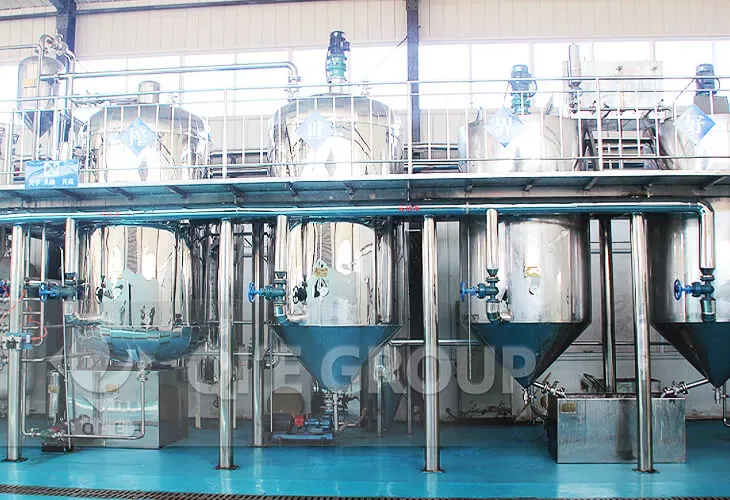
These aren’t just theoretical concerns—they’re daily realities for refiners in Europe, India, and Southeast Asia. At QIE Group, our automated de-gumming units integrate real-time sensors for pH, temperature, and viscosity, reducing manual errors by over 60% compared to traditional setups.
Pro Tip: Always pre-test your raw oil for phospholipid content before selecting a de-gumming method—it’s the single biggest factor influencing process choice and cost efficiency.
If you're looking to upgrade your refining line with precision-engineered equipment that delivers consistent results across different feedstocks, let’s talk. Our team has helped over 120 global clients optimize their de-gumming stages—from small-scale mills to industrial-scale operations.
Explore QIE Group Advanced De-gumming Solutions