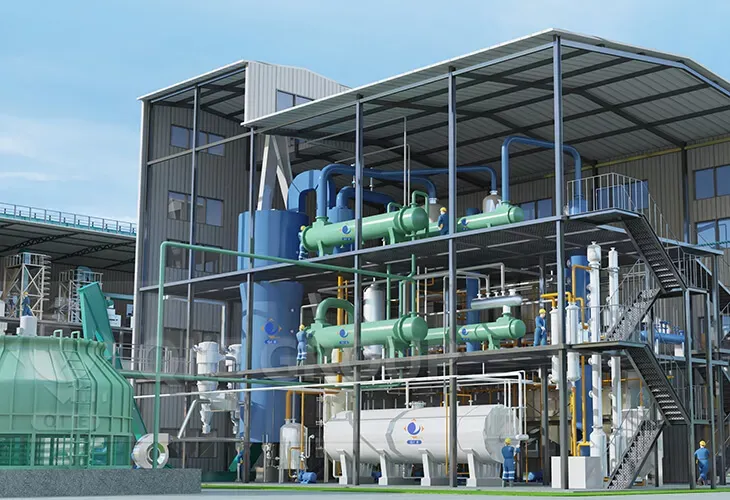

You’re likely familiar with the critical role degumming plays in edible oil refining—it’s not just a step; it’s the foundation that determines your final product quality, downstream processing efficiency, and even equipment longevity. Whether you're managing a small-scale plant or overseeing a large production line, selecting between water-based degumming and acid-based degumming should be based on science—not guesswork.
Water degumming relies on hydrolysis of phospholipids using water or dilute acid (typically 0.1–0.5% citric acid). It's ideal for oils with low free fatty acid (FFA) content (<1%)—like soybean or canola oil—and typically operates at 60–70°C. In contrast, acid degumming uses phosphoric acid (usually 0.2–0.5%) to convert gums into insoluble phosphatides, making it suitable for high-FFA oils such as palm or sunflower oil.
| Parameter | Water Degumming | Acid Degumming |
|---|---|---|
| Optimal Temp (°C) | 60–70 | 50–60 |
| pH Range | 5.5–6.5 | 2.5–3.5 |
| Mixing Speed (rpm) | 150–250 | 100–200 |
If you're processing soybean oil, water degumming at 65°C with pH 6.0 and mixing speed around 200 rpm will give you >95% gum removal efficiency. But if your feedstock is high-FFA rapeseed oil (say, FFA > 2%), switching to acid degumming at 55°C with 0.3% phosphoric acid gives better results—up to 98% gum elimination compared to only 85% with water-only methods.
Remember: improper parameter settings lead to real-world issues. For example, running water degumming above 75°C may cause protein coagulation, leading to emulsification—a common reason for oil haze after centrifugation.
These aren’t hypotheticals—they’re what our clients report weekly in their refineries. A single misstep in degumming can cascade into higher soap stock volumes, increased neutral oil loss, and more frequent maintenance cycles.

The truth? The right degumming method doesn't just improve yield—it boosts your entire operation’s reliability. By optimizing this early stage, you reduce downtime, lower chemical costs, and enhance shelf life consistency across batches.
Ready to refine smarter—not harder? Explore how our industrial-grade degumming solutions have helped over 50 manufacturers increase throughput by up to 18% while cutting gum residue by 30%. Let us help you turn process variability into predictable performance.